Somewhere in your house there's a box. It has a couple of trophies, some ribbons, maybe a jersey that doesn't fit anymore. You keep telling yourself you'll do something with it.
This is the guide for doing something with it.
This is part of our Complete Guide to Youth Sports Gifts.
The box of trophies in the basement
Every sports parent has the box. It starts small — a first participation medal, a curling team photo — and then it grows. By the time your kid is twelve, it's two boxes, and one is in the garage.
The honest problem: the box is storage, not memory. Nobody opens it. The trophies fade, the medals blur together, and the one thing you'd actually want — how small they looked in that first oversized jersey — isn't in there, because you never printed the photo.
A memory book fixes that. It's not a scrapbooking project that eats your weekends — it's a system: a little capture each season, organized once a year, so a decade from now you have something to flip through instead of a tub you feel guilty about. Start this year, because the seasons you haven't captured are the ones you're about to lose. Memory is generous in the moment and stingy a year later.
Starting from year one (or starting late)
If your kid is just starting out, you have the easy version. Make one rule: at the end of every season, spend thirty minutes capturing it before the next one starts. That's the whole system, and you'll never have a backlog.
Most parents aren't starting from year one. They're at year six with two boxes and 4,000 phone photos. That's fine — build the book backward:
- Do the current season first. It's freshest. Get one season into the system, see how it works, then work back.
- Go year by year, not photo by photo. Reconstruct one season at a time: what team, what year, what stands out.
- Let a lot go. You don't need every photo or every participation medal. A memory book is editing, not hoarding.
- Ask the other parents. The team photo you never took is in someone's group chat. Retroactive building is a team sport.
The goal isn't a perfect archive. It's a book your kid will actually open. Gaps are fine — a half-remembered season with one great photo beats a complete season nobody looks at.
What to capture each season
The trap is thinking you need a lot. You don't. The minimum viable capture fits on a sticky note, and if that's all you ever do, you'll still have something wonderful in ten years.
Here's the per-season checklist. The "book" column is worth thirty minutes; the "box" column can stay in the box.
| Capture this each season | Goes in the book | Stays in the box |
|---|---|---|
| Team photo | Yes — the anchor of the page | — |
| One action shot | Yes — them actually playing | Duplicates and blurry ones |
| One celebration/candid | Yes — the human moment | — |
| Jersey number + team name | Yes — write it down now | — |
| Season record or a stat or two | Yes, if you have it | Full scorebooks |
| A trophy or medal | A photo of it | The trophy itself |
| A one-line memory | Yes — "cried, then scored" | — |
That last row is the secret weapon. One handwritten line per season — the inside joke, the coach's nickname, the game they'll never forget — is what your kid lingers on years later. Stats fade. "The season he refused to take off his cleats" does not. Write it down the week the season ends. You will not remember the jersey number in three years. Nobody does.
Photo organization and selection
You have hundreds of photos per season and you need three. That's the whole discipline.
The 3-photo rule. Every season gets exactly three photos:
- The team. The whole squad, so future-them can point at friends they've forgotten.
- The action. Them in motion — mid-swing, mid-stride, mid-save. Playing, not posed.
- The celebration. The dugout pile-on, the orange-slice grin, the exhausted post-game hug.
Three per season keeps the book honest and keeps you from drowning. If they play travel and rec the same year, that's two "seasons" — six photos.
To pick three from hundreds, don't scroll endlessly: favorite your top ten fast, then cut to one team, one action, one celebration. Trust the gut pick — the photo you stop on is the right one. Keep the originals in a dated folder ("2026 — Spring — Wildcats U10"), but the three you choose get printed. A photo that lives only on a phone isn't a memory. It's a file.
The trading card spread
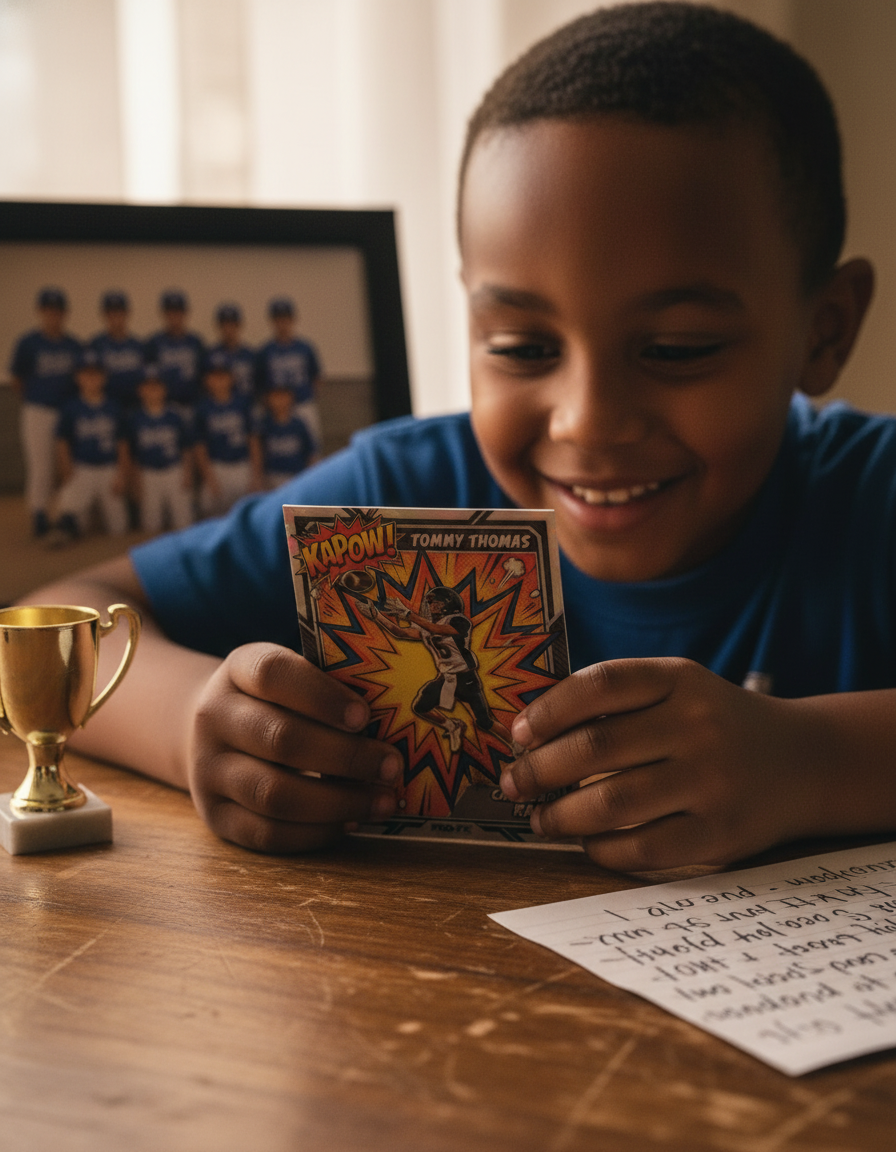
The centerpiece of the memory book: one custom trading card per season, per sport. Your kid at age 7 in their first soccer jersey, then at 9 in baseball, then at 12 in travel ball. Same format, different years. Flip through them and you can watch them grow.
This spread works because trading cards are the native format for sports data. Stats, teams, years — it's all right there, in the format designed for exactly this information. A row of them across a two-page spread does what a stack of loose photos never manages: it makes the growth visible. The gap-toothed seven-year-old and the lanky twelve-year-old are the same kid, one card apart. And it scales without more work — you're already capturing a photo, a number, and a team, so a card just turns that into the spine the rest of the pages hang on.
Start the spine of the book: make one card per season at /create — upload the photo, add their name, number, team, and year. Each card takes about 60 seconds, and you can print it for the page or share it digitally. Do one for every season you've captured and lay them out in order. That row of cards, watching them grow year over year, is the heart of the whole book.
Starting late? Make a card for each past season you can reconstruct. Even an approximate one — right team, right year, a photo that's close enough — earns its place in the row.
Layout and template ideas
You don't need design skills. The best layouts are boring on purpose, because consistency is what makes ten years of seasons feel like one story.
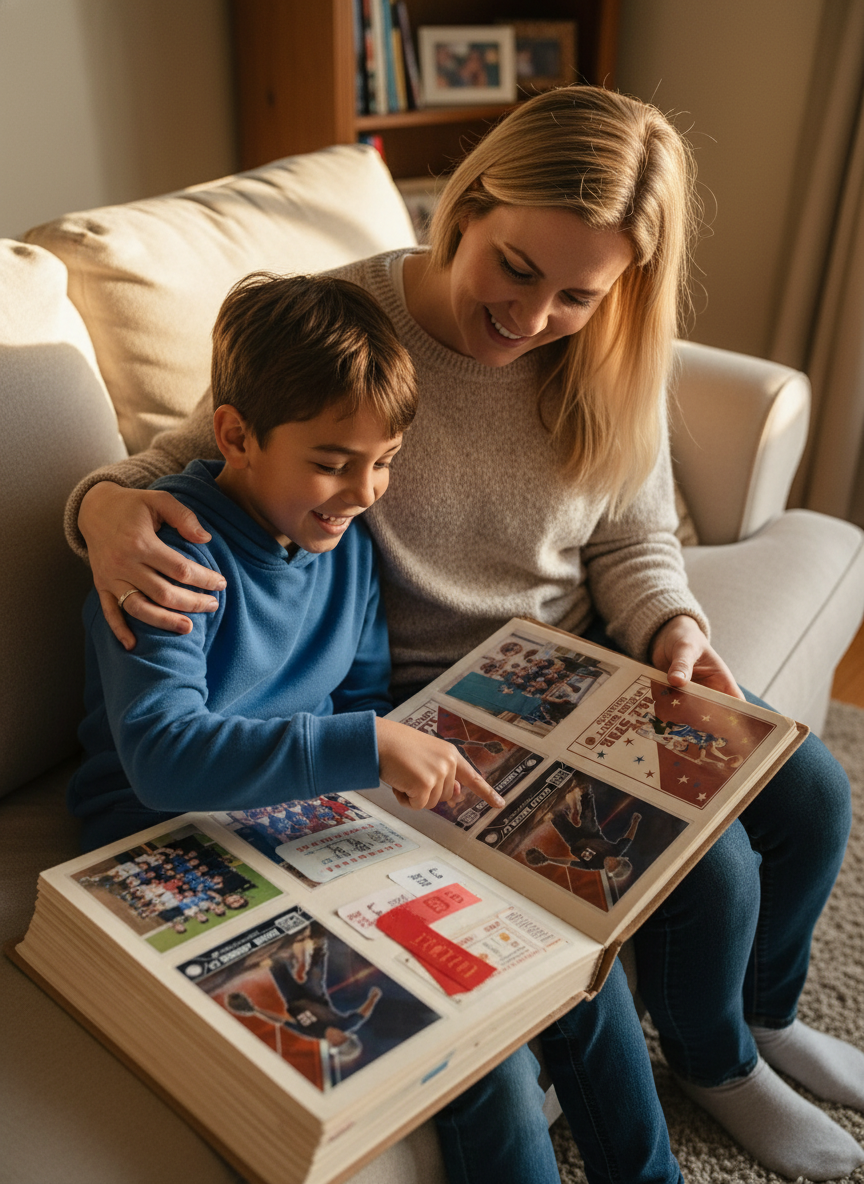
- The two-page season spread. Left: the trading card and the three photos. Right: the one-line memory, team name and record, room for a ticket stub or patch. Repeat this identical layout every season — the sameness is the point.
- The annual recap page. For a multi-sport year, add a "year in review" page up front: age, a height mark, all the teams, one sentence about the year.
- Sport dividers. Tabbed dividers by sport or year make the book navigable a decade later.
- Templates. Free options in Canva and most photo-book apps; paid scrapbook kits give more polish. Either is fine — pick one and reuse it. The worst layout is a different one every season.
Digital vs. print
Digital is where the memory book goes to be forgotten. A folder on a hard drive, a private album nobody opens — those are backups, not memory books. The whole value is being physical enough to sit on a shelf and get pulled down on a rainy day.
So go hybrid: capture and store digitally (dated folders, backed up in two places), but assemble physically — a print-on-demand photo book (Shutterfly, Mixbook, Artifact Uprising) or a three-ring binder with page protectors. The binder wins if you want to add one season at a time without reprinting the whole thing. The test is simple: when your kid is twenty-five, which version do they open? It's never the folder.
Across multiple kids and multiple sports
Two or three kids, all playing different things, is where good intentions die. The principle: one book per kid, always. A combined family archive is tempting, but it means no kid ever gets to hold their book — the one that's just about them. When they move out, they each take their own.
To keep it sane, use the same system for every kid (one template, the same three-photo rule) and batch the work — do everyone's thirty minutes in one sitting at season's end. If two kids are on the same team the same season, the same team photo goes in both books, each with that kid's own card and action shot. Shared moment, separate stories.
Passing it to them when they leave home
Here's the part you don't see coming. You build the book for yourself — a project, a way to deal with the box. Then one day it stops being yours.
Graduation, the move to college, the first apartment, their own kid someday. There's a moment when you hand it over, and it lands harder than you expect. A decade of seasons, in order, in their hands. The first oversized jersey. The row of cards where you can watch them grow up. The one-line memories in your handwriting.
Tuck a letter inside the front cover first. Keep it short. Tell them what you saw across all those seasons — not the wins, but the kid: the season they got brave, the year they learned to lose, the way they always found you in the stands. They won't remember most of the games. They'll remember that you were there, and this is the proof, bound and in order.
That's what the box in the basement was always trying to be. This is how it gets there.
More from this guide: