The banquet is the one night of the year when every kid on the team is in the same room at the same time, dressed up, with their parents. It's the moment that closes the season — and most teams completely waste it on generic trophies from a catalog.
This is part of our Complete Guide to Youth Sports Gifts.
The banquet trap
Here's how it usually goes. Someone books the back room of a pizza place. A parent orders a stack of identical gold trophies from a catalog — the little figure mid-swing, a plastic column, an engraved plate with the team name and "2026." The coach reads twelve names off an index card. Each kid walks up, gets the same trophy, sits back down. By the third name, the other eleven kids are on their phones.
Forty-five minutes later everyone's eaten cold breadsticks, the trophies are in a pile by the door, and half of them will be in a garage box by August.
That's the banquet trap: treating the one night the whole team is together as a formality to get through instead of the moment it could be.
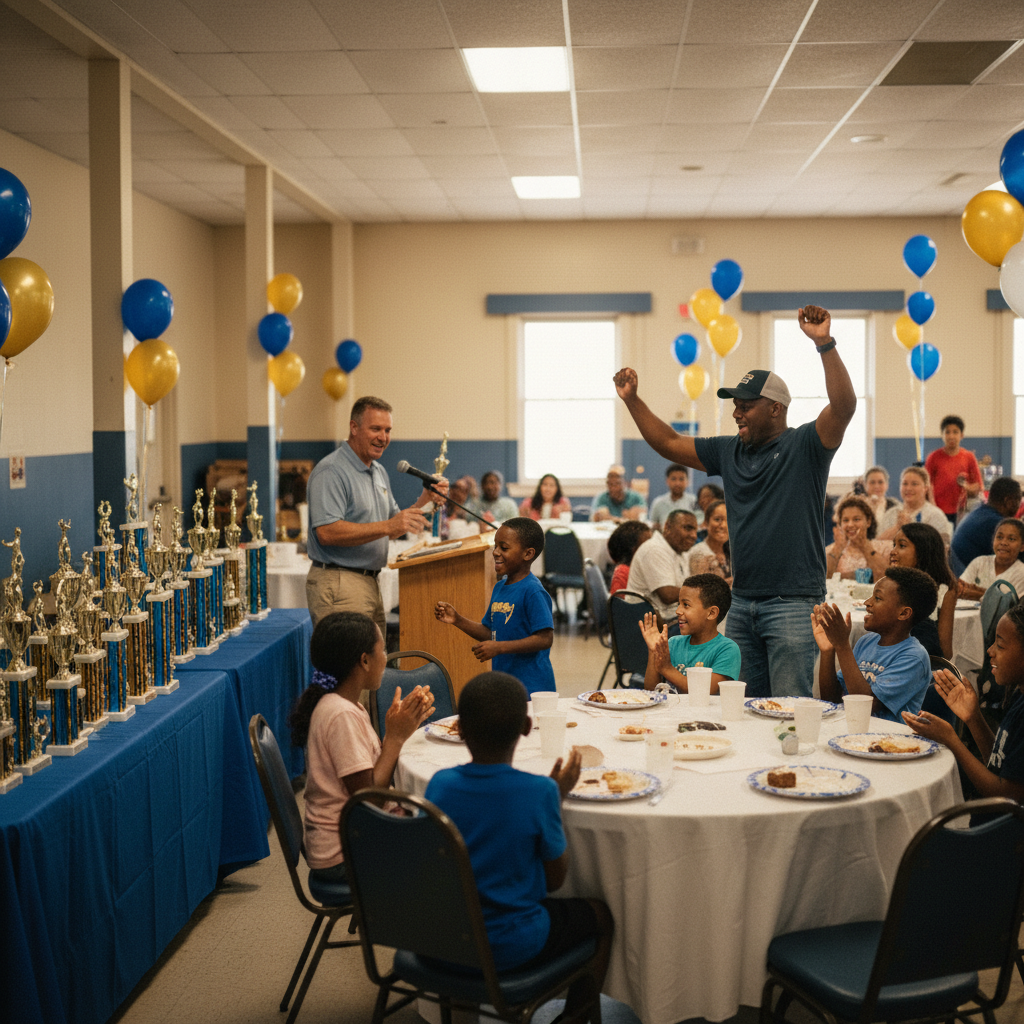
A great banquet does the opposite. It's loud. Every kid gets called up for something that's actually about them, not a mass-ordered figurine. There's a slideshow that makes the parents laugh and a couple of them tear up. Kids are out of their seats, comparing something, trading something, showing their grandma. Nobody's on a phone because they don't want to miss their name.
The difference isn't budget. It's whether the night is built around the kids or around the schedule.
Banquet planning checklist
Start earlier than you think. The teams that pull off a great banquet aren't more organized by nature — they just started three weeks out instead of three days.
Here's a rough timeline you can steal:
| When | What to lock down |
|---|---|
| 3–4 weeks out | Pick the date, confirm the venue, decide catered vs. potluck |
| 2–3 weeks out | Collect photos from every family, start the slideshow, assign award categories |
| 1–2 weeks out | Order or make take-home gifts, confirm headcount, test the AV |
| Final week | Print awards and cards, buy decorations, write the coach's speech notes |
| Day of | Arrive 60–90 minutes early, set up displays, cue the slideshow, breathe |
A few jobs to hand out so it doesn't all land on one person:
- A photo wrangler who collects shots from every family (a shared album link works well)
- A slideshow builder — one person owns it, or it never gets finished
- An awards lead who makes sure every kid has a category
- A setup crew of two or three parents for the day-of
- An AV person who owns the projector, the speaker, and the "why won't this cable work" moment
The single most common banquet failure is the AV setup. Test the projector, the sound, and the actual video file in the actual room before kids arrive. "I'll just AirPlay it" has killed more slideshows than any other sentence.
Award category ideas beyond MVP
The best awards trick in youth sports: every kid gets one. Not a participation trophy — a specific, named award that fits who they actually were this season. The kid who never missed a practice knows they never missed a practice. Naming it out loud in front of their parents is the gift.
MVP and Most Improved are fine, but you only get two of those. Here's how to make sure all twelve kids walk up for something real:
| Award | Who it's for |
|---|---|
| Iron Glove / Brick Wall | The defender nothing gets past |
| Comeback Kid | The one who turned a rough start around |
| First to Every Practice | The kid whose parent is also always early |
| Loudest in the Dugout | The energy of the bench |
| Most Coachable | The one who took every note and used it |
| Ice in the Veins | Calmest in the big moment |
| The Spark | Changes the game the second they check in |
| Utility Player | Played every position without complaint |
| Best Teammate | Voted by the kids, not the coaches |
| Highlight Reel | Owner of the one play everyone still talks about |
Let the coach and assistants divvy these up a week ahead so the fit is real — a generic award handed to the wrong kid is worse than no award. And keep the reasons short and specific when you read them out: "First to Every Practice — Maya was on the field stretching before I even parked the car." That one sentence is the part the kid remembers.
Gift ideas every kid takes home
Whatever you hand kids on the way out falls into two buckets: stuff they keep, and stuff they lose in the car.
Consumables — candy, a cheap medal, a foam finger — are fun for the night and gone by the weekend. That's fine for filler, but the real take-home gift should be something with their name on it.
What actually survives the ride home:
- A custom trading card of the kid — their photo, number, and season stats. Small, personal, and the one thing on this list that's specifically them (more on the reveal below)
- A printed team photo for each family, not just posted in the group chat
- A signed team ball or poster the kids passed around to sign during the banquet
- A simple roster keepsake — a magnet, a printed lineup card, or a mini pennant with every kid's number
The test is easy: would this still exist in a drawer next year? A dollar-store trophy fails it. Something with the kid's face or name on it usually passes.
Decoration ideas on a budget
You do not need a decorator. You need the team colors and a lot of photos.
Cheap, high-impact ideas:
- Streamers and a plastic tablecloth in the two team colors. Ten dollars, and the room instantly reads as "this is our night."
- A season-in-review board — a trifold posterboard covered in printed action shots, at least one per kid. Kids swarm this. So do grandparents.
- An action-shot gallery — string a line of twine and clip photos along it with mini clothespins
- A centerpiece per table built around a game ball, a few flowers in the team colors, or a stack of the kids' cards
- Balloon bunches in the team colors anchored at the entrance and the awards table
Print the photos at the drugstore for pennies each. The point isn't polish — it's that a kid walks in and immediately spots themselves on the wall. That's the whole trick: make the room about the kids, and it feels expensive even when it cost forty bucks.
The "trading card draft" reveal moment
Instead of calling each kid up for an identical trophy, hand them an envelope.
Inside is their own custom trading card — their photo, their name, their number, their stats from the season, in the same format as the cards they actually collect. You call a name, they open the envelope, and for a second they just stare at it. Twelve times in a row, you get the same quiet, delighted double-take.
Then the room changes. Kids are out of their seats holding cards up next to each other, reading the backs, comparing stat lines. Somebody wants somebody else's card. And the trading starts — which is the part they'll still be talking about at the next practice.
Try it: Make a card for every kid on the team — upload each player's photo, add their name, number, and a stat from the season. Each card takes about 60 seconds, and you can print a set to hand out in envelopes at the banquet. One card per kid turns the awards ceremony into the best part of the night.
It costs about the same as a stack of catalog trophies, and unlike the trophies, the cards go home in a backpack instead of a garage box. If you're doing the whole roster, our Team Mom Gift Ideas guide covers coordinating photos and payment across a dozen families.
Speeches, slideshows, and the highlight reel
Keep the talking short. The banquet dies when the speeches run long.
- The coach speaks, briefly. Five minutes, tops. The best coach speeches are specific — one real memory per kid beats a general "great season, everyone."
- One parent thanks the coach. Ninety seconds. This is also the moment to hand over the coach gift (see 27 End-of-Season Coach Gifts for what to actually give).
- Skip the open mic. It always runs long, and someone's little brother ends up with the microphone.
The slideshow is the centerpiece. Twenty to forty photos with every kid in it at least twice, set to two or three songs the kids actually like. Five minutes is plenty — a fifteen-minute slideshow loses the room. If a parent can cut a short highlight video from game footage, play it once, loud, and let the kids cheer at their own plays.
Two rules that save the night: make sure every kid appears in the slideshow (a kid who's left out will notice, and so will their parent), and test the sound before anyone sits down.
Venues and food on a budget
You don't need a banquet hall. Some of the best team banquets happen in a school cafeteria with folding tables and a potluck.
Venue options that cost little or nothing:
- The school gym or cafeteria — often free if your league is affiliated
- A park pavilion or picnic shelter — cheap to reserve and great in warm weather
- A church or community-center multipurpose room
- The back room of a pizza or barbecue place — usually free if the group orders food
On food, the honest math:
- Potluck is cheapest and surprisingly good — assign categories (mains, sides, drinks, dessert) so you don't end up with nine bags of chips
- Pizza and a couple of salads feeds a big group for very little and every kid eats it
- Simple catering or a taco bar if the budget's there and you'd rather not coordinate dishes
Whatever you choose, feed the kids first and fast. Hungry kids don't sit through awards. Get food handled early, then move into the slideshow and the card reveal while everyone's happy and full.
The banquet doesn't have to be expensive to be the night the kids remember. It just has to be about them.
More from this guide: