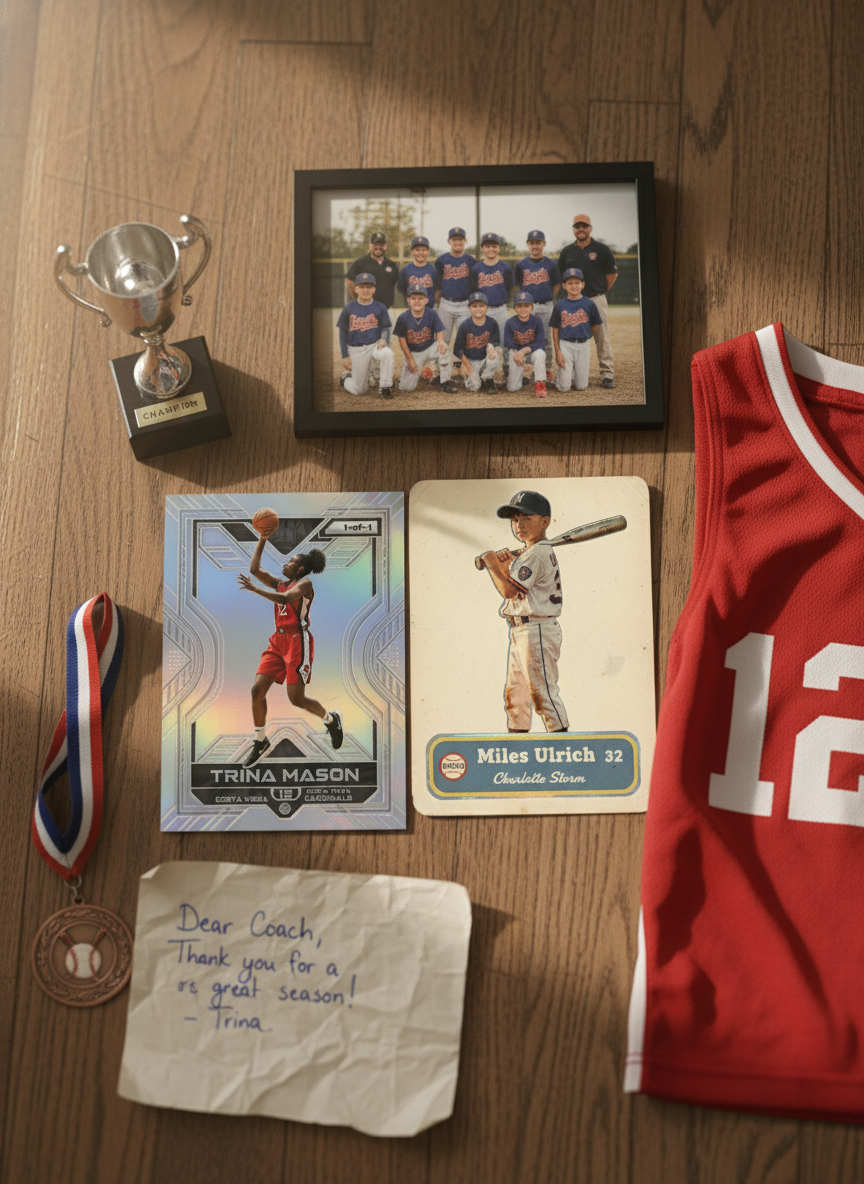

Football is the sport that looks best on a card. No other game gives you the same raw material: a lineman coiled in a three-point stance, a quarterback stepping into a throw with the ball cocked behind his ear, a running back with one arm out breaking a tackle. Those are the images that made football cards feel like posters you could hold. And now you can put your own player — your kid, your whole Pop Warner roster, the senior playing his last home game — right into that same format.
Here's how to make custom football cards from a single photo, and how to make them look like the sport actually plays.
The photos that make a great football card
Football is built for the action shot, and the card format rewards that. A few of the frames that turn out best:
- The three-point stance. Low, loaded, eyes up. It reads as football instantly, even in silhouette. Great for linemen, who almost never get their own card anywhere else.
- The mid-throw quarterback. Front foot planted, ball back, off-hand pointing downfield. This is the classic QB card pose for a reason.
- The helmet-off portrait. After the game, helmet under one arm, face visible. This one carries the emotion — the sweat, the grass stains, the look. Perfect for senior night.
- Breaking a tackle. A ball carrier with a defender sliding off him, or a stiff-arm at full extension. Motion and contact in one frame.
- The sideline hero shot. Chin strap dangling, eye black smeared, staring across the field. Half the pro rookie cards you remember are basically this.
You don't need a photographer. A parent on the fence line with a phone catches these every Saturday. Shoot a little lower than eye level if you can — looking slightly up at a player makes them look bigger, which is exactly what football cards want.
For the full walkthrough of uploading and generating, see How to Make a Custom Trading Card. The steps below are the football-specific version.
Put real stats on the back
The front is the poster. The back is where a football card earns its credibility — and football has the stat lines to fill it. The trick is matching the stats to the position, the way real cards do. A wideout's card shouldn't show passing yards; a lineman's shouldn't be blank.
Here's a cheat sheet for what belongs on the back by position:
| Position | Stats that belong on the back |
|---|---|
| Quarterback (QB) | Passing yards, passing TDs, completion %, INTs, QB rating; add rushing yards for a dual-threat |
| Running back (RB) | Rushing yards, rushing TDs, yards per carry, receptions, longest run |
| Wide receiver / Tight end (WR/TE) | Receptions, receiving yards, receiving TDs, yards per catch, longest reception |
| Offensive line (OL) | Games started, pancake blocks, sacks allowed, "anchored the left side" — narrative counts here |
| Linebacker / Defensive back (LB/DB) | Total tackles, tackles for loss, sacks, interceptions, forced fumbles, pass breakups |
| Defensive line (DL) | Tackles, sacks, QB hurries, tackles for loss, fumble recoveries |
| Kicker / Punter (K/P) | Field goals made/attempted, long FG, PATs, touchbacks, punt average |
Don't have a full stat sheet? You don't need one. A single memorable line does the job: "3 TDs vs. Central," "Team captain," "Undefeated home record," "Special teams — never came off the field." Youth football rarely tracks official numbers, and that's fine. One true detail beats a made-up box score every time.
The art styles that suit football
Football has a look — heavy, high-contrast, a little dramatic — and the bolder card styles lean right into it. When you pick a style, match it to the sport's energy:
- KAPOW! and ON-FIRE put the player at the center of an impact — an explosive starburst or a wall of flame, like they just blew through the line. This is the most on-brand football look there is, with that Friday-night-lights intensity.
- METALLIC and GOAT-MODE read as the modern "insert" card — the chrome, refractor, and neon-glow looks everybody wanted to pull from the pack.
- VINTAGE and ALL-STAR RETRO pull the other direction: matte, classic, the leather-helmet-era feel for a throwback team set.
The same photo can become a gritty vintage card or a chrome-and-flame highlight depending on the style you choose, so it's worth generating a couple to see which one fits the player.
Try it now: Make your first football card free — upload a photo, add a name, number, and position, pick a style, and see your card in about a minute. No design skills, no software to install.
Youth, Pop Warner, and travel football
This is where custom football cards get used most. A few real situations they fit:
- One card per season. Youth players grow fast. A card each fall — same kid, bigger pads, new number — becomes a stack you'll be glad you kept.
- Pop Warner and rec league. These kids will never appear in a licensed set, which is exactly why a card of their own means so much. They're on the field for the love of it; the card says somebody noticed.
- Travel and 7-on-7 teams. Long seasons, big road trips, tight-knit rosters. A full team set — one card per player — is a natural end-of-season handout, and it's a gift the coordinator can organize for the whole squad at once. Team mode makes one card per player plus collages, so you're not building 15 cards one at a time.
Custom cards fit the broader gifting calendar too — coaches, teammates, banquets — which the complete guide to youth sports gifts covers sport by sport.
Senior night and team sets
Two moments are worth planning ahead for.
Senior night is the last home game a player ever suits up for, and the helmet-off portrait was made for it. A "career" card — first-year photo on one, senior photo on another — is the kind of keepsake that survives the move to college when the trophies don't. Print a small set for the family and it becomes the thing they actually frame.
Team sets are the other big one. One card per player, printed as a real pack, handed out at the banquet — every kid loves seeing themselves in the format, and the coach can keep the whole roster in a binder. It scales cleanly: add each player, generate, and order the set together.
Print it or share it
Once the card looks right, you can download the digital version to text and post, share a link so grandparents three states away can see it, or order physical printed packs — the real, glossy, hold-it-in-your-hand version that kids actually trade. For a single card to show off, digital is perfect. For a whole team or a senior-night keepsake, the printed pack is what people keep.
The fastest way to get it is to just try one. Grab a photo from last Saturday, start a card, and you'll have a finished football card before the next kickoff.
Related guides: